How to compare car dealer offers without getting it wrong
Two offers for the same car can hide a difference of several thousand dollars. The six lines to compare, a simple grid and the most common traps.

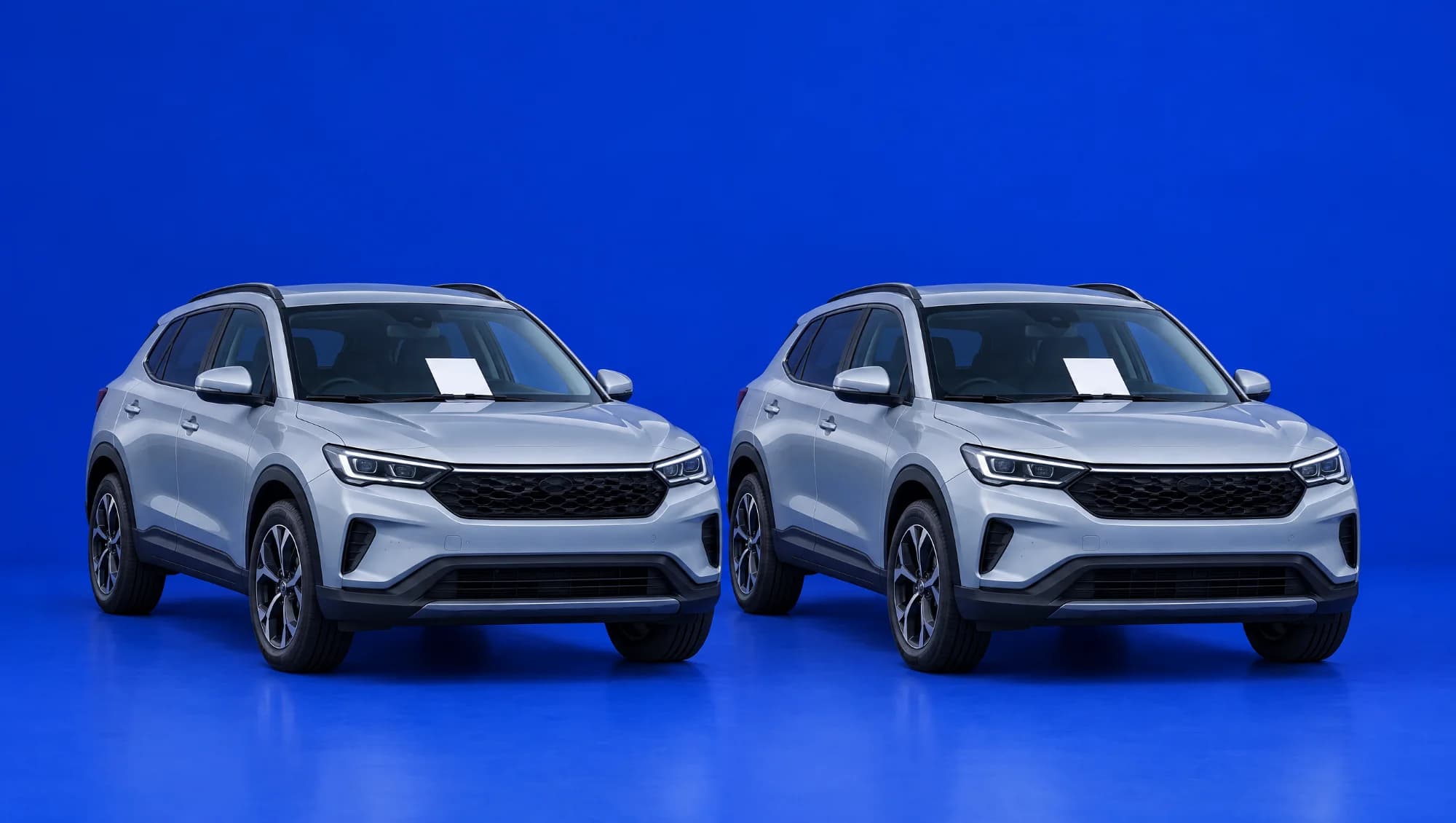
Two dealers offer you the same car. One advertises a payment of $489 a month, the other a $2,000 discount. Which is the better deal? There's no way to tell without putting both offers on the same footing: the total cost.
This guide shows you what to compare, in what order, and how to spot what isn't obvious at first glance.
The short answer
Always compare the total vehicle price before taxes, then the total cost of financing, for the same trim, the same options and the same term. A lower monthly payment doesn't mean a better offer: it often hides a longer term or a higher rate.
Step 1: make sure you're comparing the same car
Before talking money, make sure both offers are for an identical vehicle:
the same model year (a leftover 2026 and a 2027 aren't worth the same);
the same trim (for example LX, EX or Touring: the difference can exceed $5,000);
the same option packages and the same colour, if it costs extra;
the same engine and the same drivetrain (front-wheel or all-wheel drive).
If a dealer offers a different trim because yours isn't in stock, ask for the price of the exact trim you want, even if it means waiting for delivery.
Step 2: compare the vehicle price, not the payment
In Quebec, the Consumer Protection Act requires all-inclusive pricing: the advertised price must include everything you'll have to pay, including freight and PDI, the federal air conditioner excise tax and administration fees. Only the GST, the QST and the new tire duty can be added. A dealer can't charge more than the advertised price unless you ask for additional products or services.
Ask each dealer for a written breakdown, then compare line by line. Freight, PDI and administration fees must already be included in the advertised price: if they're added on top, that's a red flag. Here are the two offers from the introduction, broken down (fictional example, rounded amounts):
Line | Offer A | Offer B |
|---|---|---|
Advertised vehicle price (all-inclusive) | $27,500 | $27,500 |
Dealer discount | $0 | −$2,000 |
Manufacturer rebate | −$500 | −$500 |
Add-on products (rustproofing) | +$1,200 | $0 |
Total price before taxes | $28,200 | $25,000 |
GST and QST (14.975%) | $4,223 | $3,744 |
Amount financed | $32,423 | $28,744 |
Rate and term | 6.99%, 84 months | 6.99%, 60 months |
Monthly payment | $489 | $569 |
Total paid by the end | $41,092 | $34,142 |
Offer A shows the lowest payment, but it costs about $6,950 more in total. Three reasons: no dealer discount, $1,200 of rustproofing added to the price, and an 84-month term instead of 60. Even over 60 months, it would still cost about $4,370 more. Do the same exercise with the offers you receive: it's the only way to see whether a "big discount" or a "low payment" is being made up for somewhere else.
To understand each of these lines, read our guide on the real price of a new car.
Step 3: compare the cost of financing
If you finance or lease, the price is only half the story. For each offer, write down:
the interest rate (or credit rate);
the term, in months;
the payment, and how often it's due (monthly, biweekly);
the total credit charges, meaning everything you pay on top of the price;
the total amount you'll have paid by the end.
By law, the credit contract must show the cash price, the credit charges in dollars, the total obligation (what you'll pay in all) and the credit rate. Ask for these amounts before you sign, not after. And know that you can cancel a credit contract at no cost within two days of receiving your copy.
A "0%" rate isn't always a real 0%
The credit rate must account for everything you pay for the credit, including the discount you would have gotten by paying cash. If the car costs less paid in cash than with 0% financing, the real rate isn't 0%. The Office de la protection du consommateur (Quebec's consumer protection office) advises asking whether the advertised rate is in fact the credit rate shown in the contract.
Why the monthly payment is misleading

A longer term lowers the payment but raises the total cost. Fictional example, for an amount financed of $35,000 at the same 6.99% rate:
Term | Approximate monthly payment | Approximate total interest |
|---|---|---|
60 months | $693 | $6,570 |
84 months | $528 | $9,360 |
Over 84 months, the payment drops by about $165, but you pay nearly $2,800 more in interest. And the longer the term, the greater the risk of owing more than the car is worth during the first few years. The Office de la protection du consommateur has in fact warned against financing over 5 to 8 years: in its example, a $37,999 car costs more than $7,300 in credit charges over 72 months.
Also watch out for negative equity: when the debt on your old vehicle is rolled into the new loan, you pay interest on a car you no longer have.
Step 4: keep your trade-in value separate
If you're trading in your vehicle, a dealer may offer more for your trade-in and a smaller discount on the new car, or the reverse. The result can be the same. To compare fairly:
get your vehicle appraised separately, before discussing the new car;
compare the net amount (price of the new car minus the trade-in value) from one offer to the next.
In Quebec, when an individual trades in their vehicle at a dealership, the GST and QST are calculated on the price minus the trade-in value. So every dollar you get for your trade-in also saves you about 15% in taxes. Our guide How much is my car worth? explains how to estimate its fair value.
Step 5: spot the add-on products
Rustproofing, paint protection, extended warranty, replacement insurance: these products can be useful, but they're often added to the financing, which makes them cost more once interest is included. For each product:
ask for its separate price;
remember that it's optional: no merchant can require you to finance your purchase either;
compare with what the same product costs elsewhere.
For an extended warranty, the merchant must first tell you about the legal warranty, which already applies at no charge. You can also cancel an extended warranty at no cost within 10 days.
For rustproofing in particular, read Rustproofing a new car: necessary or not?
Step 6: look at what doesn't have a price tag
When prices are equal, other factors can tip the balance:
the delivery time and the date the offer expires;
the distance to the dealership, for warranty servicing;
the conditions attached to a discount (mandatory financing through the manufacturer, for example);
the clarity of the offer: a detailed written offer is worth more than a promise over the phone.
The most common traps
Comparing payments over different terms. Bring everything back to the total cost.
Leaving taxes out of the budget. The GST and QST (nearly 15% combined) are added to the advertised price.
Confusing manufacturer rebates with dealer discounts. Manufacturer rebates are generally offered everywhere; only the dealer discount is truly worth comparing.
Signing the same day under pressure. A good written offer is still good the next day.
Frequently asked questions
How many offers should you compare?
In general, three offers are enough to get a good idea of a model's market price. Beyond that, the gaps between offers tend to narrow.
Can you negotiate an offer you've already received?
Yes. A written offer from one dealer is a good starting point for a discussion with another. Stick to the facts: present the numbers, not just the payment.
Is an offer without taxes normal?
Yes. The law allows a price to be advertised without the GST and QST, which apply the same way everywhere in Quebec. All other fees must be included, except the new tire duty ($4.50 per standard-size tire).
Get several offers without touring dealerships
Comparing offers takes time: calling, driving around, asking for breakdowns, starting over. As soon as it launches in Quebec, bolyd will save you that work: you'll describe the car you want just once, and dealers will send you their offers. You'll compare them in one place, at your own pace, and only talk to the dealer you choose.
bolyd is coming soon to Quebec
Describe the vehicle you want and get offers from dealers. Leave your email to hear when we open.